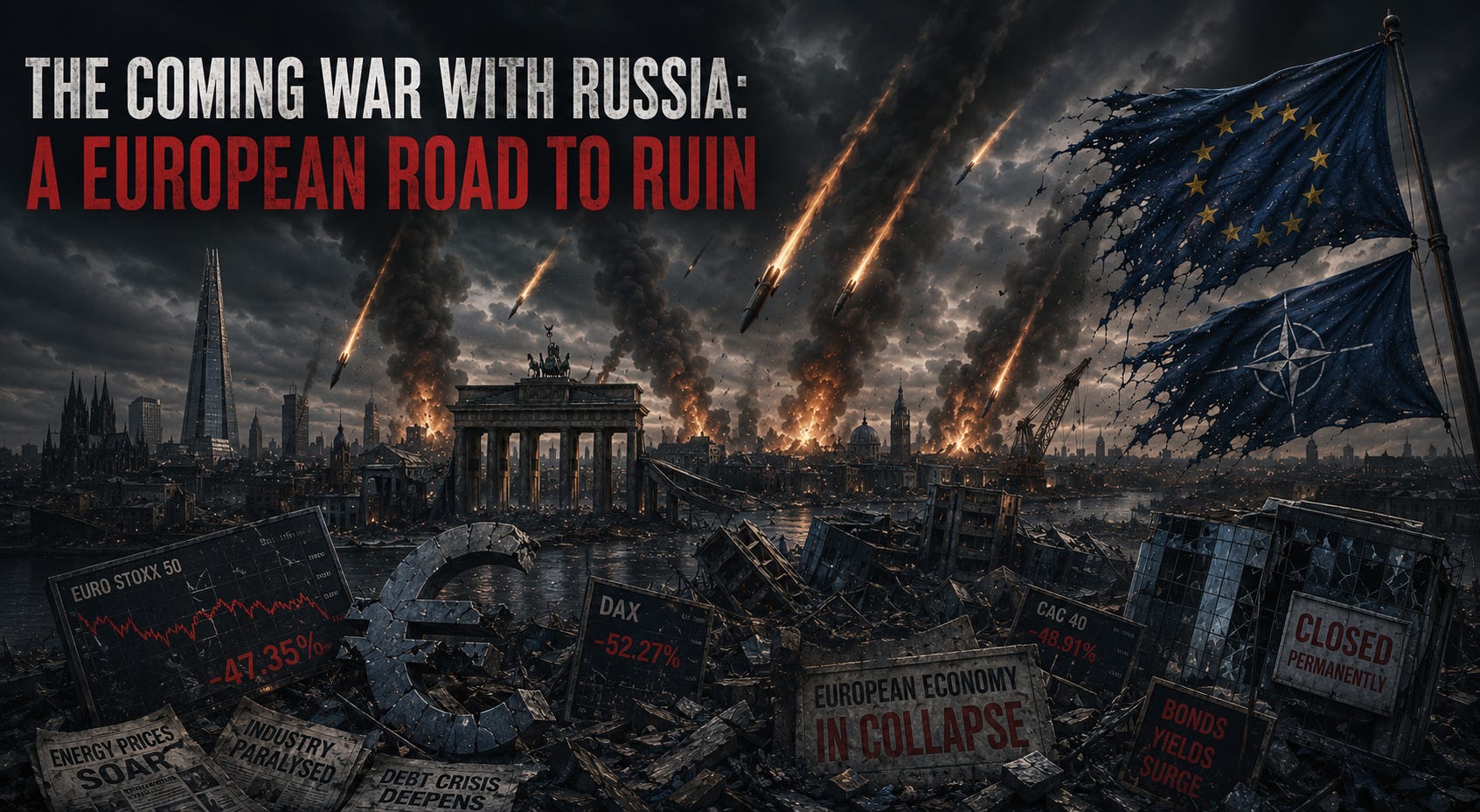
Because we cannot adequately defend against conventional ballistic missiles and have no defense against hypersonic missiles, the damage to our economies would be catastrophic.
Executive Summary
NATO, EU and E3 leaders are taking Europe down a path to be ready for war by 2030. In the light of European bellicosity, Russia could decide to start this sooner. If so, the US would be unwilling to fight Russia on Europe’s behalf. Unable to defend itself against Russia’s conventional ballistic/hypersonic missiles, Europe would suffer a rapid defeat and very high military losses. Even after suing for peace, destruction of Europe’s energy system would plunge Europe into economic crisis. Europeans should be invited publicly to debate these risks and have their views heard.
1. Introduction – Understanding War’s Nature
As European leaders’ calls to be ready for war with Russia by 2030 grow ever louder, we would do well to consider the advice of war’s greatest philosopher, General Carl von Clausewitz:
‘Wars must vary with the nature their motives and the situations that give rise to them. The first, the supreme, the most far-reaching act of judgement that the statesman and the commander have to make is to establish by that test the kind of war on which they are embarking; neither mistaking it for, nor trying to turn it into, something which is alien to its nature. This is the first of all strategic questions and the most comprehensive.’[1]
We should think hard on the nature of war with Russia: how our leaders’ public statements are heard in Russia; when such a war might start; how it might unfold; what its consequences and costs might be. This article builds one such scenario.
2. The Strategic Context
To begin, we must understand how we got here. It is clear, to anyone familiar with strategic history, that the roots of the crisis run back to 1989. When the Berlin Wall fell, there was an opportunity to build a durable, inclusive European security architecture — one that accommodated Russia’s legitimate security interests. That opportunity was squandered. Through the 1990s and 2000s, despite the original reassurances offered to Russia, NATO expanded relentlessly eastward. Prescient voices of caution — Kennan, Matlock, Burns, Kissinger, Mearsheimer— were dismissed or ignored. So too were Russia’s explicit and repeated red line warnings.
The Russo-Ukraine War must be understood in this context. The West is replete with conventional opinion that Russia intervened for imperial ambition. But all the credible evidence suggests that Russia went to war because it concluded — rightly or wrongly — that NATO expansion represented an existential threat. In Russia’s eyes, this was – and still is – a defensive war of survival.[2] Not surprising given that Kaja Kallas, EU foreign policy lead, has called publicly[3] for the breakup of Russia. Whatever one thinks of Russia’s methods, understanding its motivation is critical to understanding the nature of our future war with Russia.
3. Russia responds to European Escalation
Notwithstanding this fundamental insight, the publicly stated intention of the E3’s leaders — Macron, Merz and soon, no doubt, Burnham — is to increase the supply to Ukraine of long-range precision drones and cruise missiles, all capable of striking deep into Russian territory. In response, Moscow’s public warning is unambiguous: if this continues, directly targeting European production facilities will not be ruled out.
If E3 leaders choose not to take this warning seriously – a logical assumption, given that they have ignored all of Russia’s previous warnings – it is quite possible, even likely, that such a conflict could start this year, much earlier than Europe’s planned 2030. The second half of 2026 is thus taken as the start line for this scenario.
In September 2026, with its warnings ignored, and attacks into the Russian heartland increasing with E3 increased weapons deliveries, Russia acts. Conventional ballistic missile and hypersonic strikes destroy key E3 drone and missile production facilities in the Britain’s Midlands, the Ruhr, and outside Bordeaux. NATO Article 5 is invoked. But Article 5 does not require military action — it requires each member to take ‘such action as it deems necessary’. The shallowness of the guarantee upon which E3 leaders assumed they could rely is now exposed.
Spain and Hungary decline to commit forces. Italy, Poland, and several Eastern European members equivocate. More importantly, the White House, after recently appearing to shift to support operations against Russia now has urgent second thoughts. Having just lost a war in Iran, with badly depleted ammunition stockpiles, no domestic appetite for US troops fighting and dying on the other side of the Atlantic, and the mid-terms ahead, ‘Extending Russia’[4] does not look like such a good idea. The White House quickly concludes it is not in the US national interest to join a war with Russia on the European mainland. After spent years talking about strategic autonomy without creating it, the E3 now know what this means.
4. The First 3 Months of the War
Nevertheless, trapped in the political narrative they have constructed, the leaders of the E3 and smaller willing nations — perhaps the Dutch, Scandinavians, and Balts — respond.
The only place where an offensive is possible is in the air. But Europe’s strike packages now discover what Ukrainian pilots have known for years. Whilst a small proportion of European cruise missiles find their targets, the majority are destroyed by Russia’s layered and well-practiced S-400 and S-500 networks, which also exact an unsustainable toll on European pilots and aircraft. Without American suppression of enemy air defences – and perhaps even with it – there is no further prospect of achieving air superiority nor any effective counter attack.
In response to the air strikes, Russia takes the gloves off, determined once and for all to remove the threat from Europe to its people and homeland. Russia strikes airfields, training bases, dockyards, logistics hubs, and marshalling yards, inflicting 1,000s of military casualties amongst European forces before they can even deploy. The Europeans now learn the lesson that the US have just learnt in the Gulf – European militaries have very little protection against conventional ballistic attacks, and none against hypersonic missiles.[5]
The point is cruelly reinforced by simultaneous Russian strikes that systematically dismantle the Europe’s energy infrastructure — gas terminals, power stations, grid interconnectors, storage facilities — with the same clinical precision applied to Ukraine’s grid from 2022 onwards. Acutely vulnerable as the world’s largest regional hydrocarbon importer, at 12.8 million barrels per day,[6] Europe’s energy system is already under severe strain — the consequence of self-defeating sanctions on Russian oil and gas, recently compounded by the Strait of Hormuz energy shock.[7]
At sea, Russian submarines have deployed into the North Sea and Atlantic, and a wartime blockade has been announced. The mere threat of losing commercial vessels is enough for maritime insurers to withdraw cover and for shipping companies to stand down. Europe’s hydrocarbon imports grind to a halt and energy systems start to fail. The lights begin to go out. More importantly, without diesel, Europe’s farming, fishing and food logistics systems fail. Although only 2-3 months into the conflict, Europe’s economic situation is now perilous.
4. The Ceasefire, Costs and Consequences
Faced with the binary choice of escalating with nuclear weapons or accepting defeat, British and French leaders pause. Both nations’ nuclear deterrents exist to deter nuclear attack on their own territories, not to take nationally suicidal action to rescue a failing conventional campaign. Meanwhile, the US – having made its position on the sidelines clear and now acutely worried about the risk of nuclear war with Russia – is urgently working with both sides to bring the war to a close. Which can only be done on Russia’s terms. Under intense pressure from the US and the smaller European nations, E3, NATO and EU leaders sue for peace.
Only 3 months into the conflict, the human costs are already severe. Military casualties are orders of magnitude higher than Western and NATO losses in 25 years of operations in Iraq and Afghanistan. But military surrender is not the end, just the beginning.
With its energy system shattered, European industrial production is collapsing, unemployment is surging. Europe’s largest countries, other than Germany, are already shouldering debt-to-GDP ratios over 100%[8]. European public finances buckle then crack under the rapidly increasing burden of emergency energy subsidies, future reconstruction costs, collapsing stock markets, bond market runs leading to higher government interest costs, and lost tax revenues.
The failed state that is Ukraine provides indisputable evidence of what comes next. An economic contraction of 10% is the conventional criterion for a depression[9]: Ukraine’s is over 30%. The US is fiscally unable – and the Rest of the World politically unwilling – to offer a Marshall Plan. Thus, Europe faces alone an economic contraction greater than the Great Depression.
The political consequences are no less profound. The coalitions that launched the war collapse, and the leaders who led the charge are rapidly and ruthlessly deposed. NATO and the European Union, both judged complicit in the war’s commission, are irreparably fractured. Populist and nationalist movements surge. Social contracts between elites and the peoples, built over generations and in societies that had not experienced war on their own soil since 1945, strain to breaking point. Europe, once a coherent political and economic region, now faces a dystopian reckoning.
5. Conclusion – The Choice Europeans Face
If this scenario is plausible – even remotely so – are the risks the E3 leaders are inviting us to accept worth it? Without any public discussion?
There is an alternative: it’s called diplomacy. Not the diplomacy of ultimatums, nor meaningless peace conferences from which one belligerent is triumphantly excluded. But rather the diplomacy of honest conversation, in which each side listens to the other. Russia’s security needs are not difficult to understand. Because they have been repeating them for 20 years, almost ad nauseam for those of us who were prepared to listen and hear. A neutral Ukraine. No NATO membership. Real security guarantees. All of which Russia was willing to offer and Ukraine willing to accept in March 2022 – before Zelensky was persuaded otherwise by Boris Johnson and Joe Biden.
As General André Beaufre wrote: ‘In war the loser deserves to lose because his defeat must result from errors of thinking, made either before or during the conflict’. Over the first quarter of this 21st Century, Western leaders in general and Europe leaders in particular have a consistent track record of ‘errors in thinking’ – as our failed operations in Afghanistan, Iraq, Libya, Syria, and now Ukraine unequivocally prove. This time though the stakes for Europeans could not be higher.
To conclude, before they march us onwards towards war, our leaders owe us two things. First, an honest, public, strategic assessment of the risks to which this course of action could expose us. Second, an opportunity for our views to be sought and our voices to be heard. After all, it is we, not they, who will be the ones expected to fight the war and bear its costs and consequences.
The choice we Europeans face is simple. Should we change course toward peace, and begin a difficult but honest diplomatic conversation with Russia? Or should we let our leaders – guided by a political narrative that they have constructed and ignoring the existential risks set out here – continue to lead us onwards towards war? As did their illustrious predecessors, a century or so ago, in the Summer of 1914?
________________________________________________
Commodore (Rtd) Steven Jermy RN is the founder of Mor Gallos and the author of Strategy for Action: Using Force Wisely in the 21st Century (2011). He offers strategic advisory services to organisations in the energy, defence, and geopolitical risk sectors. Enquiries: advisory@morgallos.co.uk
References
1. Steven Jermy, ‘Right Now NATO Could Not Win a War with Russia’, Responsible Statecraft, 29 January 2025. https://responsiblestatecraft.org/nato-war-with-russia/
2. Steven Jermy, ‘Russia Is in the Driving Seat’, Brave New Europe / NATO Watch, 15 May 2025. https://braveneweurope.com/steven-jermy-russia-is-in-the-driving-seat
3. George Kennan, ‘A Fateful Error’, New York Times, 5 February 1997; William J. Burns, ‘Nyet Means Nyet’, US Embassy Moscow cable, 1 February 2008 (WikiLeaks); John J. Mearsheimer, ‘Why the Ukraine Crisis Is the West’s Fault’, Foreign Affairs, Sep/Oct 2014.
4. ‘Oreshnik Missile Is Unstoppable, Undetectable’, The Week India, 21 December 2024. https://www.theweek.in/news/defence/2024/12/21/oreshnik-missile-is-unstoppable-undetectable-another-military-analyst-echoes-putins-claims.html
5. International Energy Agency (IEA), World Energy Outlook 2024.
6. ‘Lloyd’s Executive Likens LNG Attack to Nuclear Explosion’, Resilience.org, 20 September 2004. https://www.resilience.org/stories/2004-09-20/lloyds-executive-likens-lng-attack-nuclear-explosion/
7. Kyiv School of Economics / World Bank, Ukraine War Damage Assessment, various reports 2023–2025.
8. IMF Fiscal Monitor — General Government Gross Debt (% of GDP). https://www.imf.org/external/datamapper/GG_DEBT_GDP@GDD/
9. General André Beaufre, An Introduction to Strat
[1] Carl von Clausewitz, On War, tr. Michael Howard & Peter Paret. (Princeton, 1976) p.88.
[2] George Kennan, ‘A Fateful Error’, New York Times, 5 February 1997; William J. Burns, ‘Nyet Means Nyet’, US Embassy Moscow cable, 1 February 2008; John J. Mearsheimer, ‘Why the Ukraine Crisis Is the West’s Fault’, Foreign Affairs, Sep/Oct 2014.
[3] https://fampo.no/estonias-pm-kaja-kallas-calls-for-the-breakup-of-russia/
[4] https://www.rand.org/content/dam/rand/pubs/research_reports/RR3000/RR3063/RAND_RR3063.pdf
[6] International Energy Agency (IEA), World Energy Outlook 2024. Europe’s oil import dependency at approximately 12.8 million barrels per day.
[8] IMF Fiscal Monitor — General Government Gross Debt (% of GDP). https://www.imf.org/external/datamapper/GG_DEBT_GDP@GDD/
[9] Kyiv School of Economics / World Bank, Ukraine War Damage Assessment, various reports 2023–2025
.

No comments:
Post a Comment