Thursday, April 30, 2026


Wednesday, April 29, 2026


Tuesday, April 28, 2026


Monday, April 27, 2026


Sunday, April 26, 2026


Saturday, April 25, 2026

Friday, April 24, 2026

Thursday, April 23, 2026


Wednesday, April 22, 2026


Tuesday, April 21, 2026


Monday, April 20, 2026

Saturday, April 18, 2026

Friday, April 17, 2026


Thursday, April 16, 2026


The Vampire Economy

Excerpts From Be Water
What changed in 2008 was not so much the rules themselves as the removal of the last guardrail preventing their full application. The Financial Matrix didn’t materialize from the aether; rather, it represents the perfected digital evolution of an analog precursor whose roots stretch back nearly a century—to a revolution most Americans are unaware even occurred.
The 1930s built the underlying hardware: an institutionalized framework of state intervention masquerading as free markets. But it wasn't until the Great Financial Crisis that the system received its digital operating system upgrade—when central bank QE, ZIRP, and the blind algorithmic and passive ETF flows they enabled and amplified were deployed at sufficient scale to make them the “market” itself—effectively masking state intervention as natural market action.
That two-part revolution—the 1930s hardware of state-directed “capitalism”, digitized into the Financial Matrix OS in 2008—preserved market form while shifting their substance to the State. To understand what lies beneath the Financial Matrix’s failing disguise and to make sense of Multiflation—what is happening now, what comes next, and what it all means for your capital—we must return to the source: the Great Depression.
Garrett described how the revolutionary New Deal had succeeded through linguistic camouflage:
[It was accomplished] not only within the form but within the word, so that people were all the while fixed in the delusion that they were talking about the same things because they were using the same words. Opposite and violently hostile ideas were represented by the same word signs. This was the American people’s first experience with dialectic according to Marx and Lenin.
The facade of the U.S. Constitution and institutions remained intact, but their underlying meaning and function were now altogether different. Garrett was effectively documenting the resurrection of an ancient political art; Edward Gibbon observed the same strategy nearly two millennia earlier, when Augustus—the first Roman emperor and Julius Caesar’s adopted son—consolidated Roman imperial power:
Augustus was sensible that mankind is governed by names…the senate and people would submit to slavery, provided they were respectfully assured that they still enjoyed their ancient freedom.
The architects of the New Deal, too, understood that Americans would submit to a new order provided they were assured they still enjoyed their ancient liberties. Gibbon’s description of Augustus’ method reads as though it were written about FDR:
The image of a free constitution was preserved with decent reverence: the Roman senate appeared to possess the sovereign authority, and devolved on the emperors all the executive powers of government.
Just as Augustus had preserved the image of a free constitutional republic while concentrating all executive power in himself, FDR absorbed nearly unchecked authority while citizens continued to speak of the “constitution,” “private property,” “free markets,” “prices,” and “capitalism”—unaware that these terms now held altogether different meanings.
This apparatus of hidden state control expanded almost imperceptibly over the ensuing decades: first through the New Deal and Bretton Woods system, and then through the 1971 severance of the dollar from gold, which removed the last constraints on a fully hyperreal economy.
Then, in 2008, the financial system ruptured. What we think of as the “subprime crisis” was not a “black swan” or a one-off “market failure” caused by a few years of subprime and CDO excesses, but rather the inevitable culmination of decades spent perfecting the Vampire Economy through the dark art of risk transmutation.
The Great Financial Crisis and governmental responses—Money Printer Go BRRR—birthed a second revolution within the form, precipitating a phase transition in which the financial markets were predominantly nationalized by stealth. If the New Deal redefined the vocabulary and institutions of capitalism, 2008 digitized the Vampire Economy, birthing the Financial Matrix.
The Vampire Revealed
The Financial Matrix’s genius was its invisible system of wealth extraction from the Forgotten Man—who watched helplessly as his purchasing power was eroded, his savings devoured by inflation, his prudence punished, and his virtue mocked by a system that rewarded speculation and fraud.
Central banks stopped intervening in markets at the margins and became the market—the State the ultimate “market” participant, the remaining substance of capitalism replaced with a videogame simulation. The user interface—tickers, stock prices, property titles—remained intact, but the underlying operating system was replaced with State-conjured “liquidity”—the raw fuel for blind algorithmic flows that transmitted and amplified both across every market.
The 2008 rewrite of the global economic operating system perfected the Vampire Economy’s operating model and extended the blueprint beyond the financial markets. Governments need not nationalize what they can control by other means. After 2008, that principle metastasized invisibly across three interlocking fronts: financial, industrial, and informational.
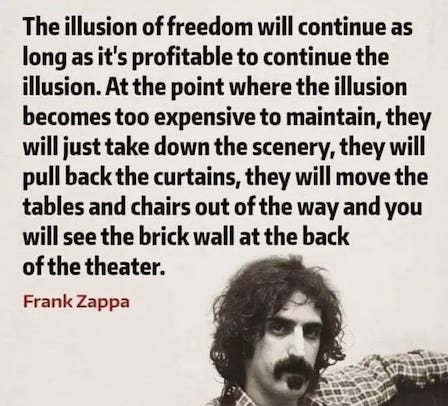
The illusion of free markets held, mostly, for twelve years after the Great Financial Crisis. Then the COVID era forced the system into overdrive, and the sheer scale of the intervention short-circuited the Financial Matrix.
As governments printed trillions and locked down the global economy, the schizophrenic disconnect between Wall Street’s manufactured prosperity and Main Street’s economic ruin became too vast to conceal. The Forgotten Man finally saw glimpses of the underlying code.
Now, as the “coppertop batteries” run dry, the Matrix is glitching, and the “desert of the real” is bleeding through the screen. The comfortable fiction of free-market capitalism died, and the Vampire Economy is laid bare.
What we are witnessing is not the birth of something new, but rather the perfection and revelation of a century-old process—and the death of the illusion that disguised it.
We have entered an era in which capital is no longer yours to deploy as you see fit; it has been redefined as a resource held in provisional custody, subject to recall whenever the sovereign sees fit. What was once private property is now a mere license—revocable, conditional, contingent on compliance.
This is the inheritance of the revolution-within-the-form. FDR’s New Deal put the State inside the market; 2008 digitized the Vampire Economy and extended it across every front of modern life. The substance migrated to the sovereign while the citizenry, comforted by familiar words and flickering numbers, scarcely noticed.
The Forgotten Man is perhaps beginning to notice now. This transition from private property to state-managed license is increasingly visible at every level of Western society: from Mamdani’s NYC; to the state level—California sweeping dormant digital assets into state coffers, Washington and a growing list of states engineering wealth and exit taxes; to the Federal policies of the Trump administration.
Nor is this a uniquely American phenomenon; it is a global movement toward a compulsory economy across the Western world. At Davos, “stakeholder capitalism,” “15-minute cities,” CBDCs, and more are championed as inevitabilities.
In Germany, proposed legislation would block individuals from purchasing homes based on "anti-constitutional" views—granting local authorities first refusal on sales and allowing intelligence agencies to vet buyers without a criminal conviction. From Ireland’s systematic use of forced purchase orders and punitive taxes to compel private property into state-mandated utility, to Canada’s debanking and agreements with first nations, private property is being compelled into the service of the state.
In Part IV, we examine what happens when the systemic failure of the Financial Matrix escapes the confines of the financial markets. History shows that when the financial illusion fails, the Forgotten Man’s rage flows toward whatever symbols of the new order are nearest at hand—the perceived architects and beneficiaries of the system.
Add the accelerant of Artificial Intelligence—which threatens to creatively destroy wide swaths of the economy—and you have the recipe for an explosive cocktail. As the vanguard of the digital economy is now discovering, that “explosive cocktail” is no longer mere metaphor, but rather a literal Molotov lobbed at their front door:
The next day, a second attack occurred at Altman’s house, this time a shooting:

These attacks are not merely isolated symptoms of societal decay or neo-luddism; they are the kinetic real-world eruptions triggered as the Financial Matrix fails and the tectonic forces of Multiflation, unleashed by its collapse, crash into one another. As the Forgotten Man’s purchasing power evaporates, the technocratic “Alternative Vision” poses a threat—whether real or perceived—of finalizing his economic obsolescence.
Wednesday, April 15, 2026


Tuesday, April 14, 2026
The Invasive Species Moves to Take Total Control

The parasite makes its final move to kill the host.
Monday, April 13, 2026

Sunday, April 12, 2026

Saturday, April 11, 2026


Friday, April 10, 2026


Subscribe to:
Posts (Atom)